About Tonkinese
Photos in this article are provided by L Vousden from her books and may not be reproduced elsewhere.
Photos in this article are provided by L Vousden from her books and may not be reproduced elsewhere.
|
1) A Quick Historical Introduction
2) What Makes A Cat A Pedigree? 3) What Does The Tonkinese Look Like? 4) What Is The Tonkinese Character? |
5) Are Tonkinese Easy To Look After?
6) Books On The Tonkinese 7) Recommended Web Sites For Extra Information |
________________________________________________________________________________________________________________
|
1) A QUICK HISTORICAL INTRODUCTION
This is a breed with a long complex history but some people still stubbornly write that it is “relatively new breed”. This cat has been bred, drawn and written about since at least the mid-1700s - in the ancient Thai Cat Book Poems and in many cat books from the late 1800s onwards. In the 1880s it was one of the exotic breeds of cat brought to the West by dignitaries and traders, from Siam. The cats were bred and registered as one of two varieties of Siamese – the ‘Royal’ Siamese with its dark points, pale body and deep blue eyes and the Chocolate (not to be confused with much later chocolate-point). The Chocolate had dark points with a warm brown body and beautiful blue-green eyes. In the 1930s the American owner of a female Chocolate called Wong Mau bred her and, with a few knowledgeable friends, developed a new breed of cat that would become known as the Burmese. At this stage the history of the Chocolate became even more complicated – if you’d like to know more there is a book on the history of Tonkinese (for details see end of page). Suffice it to say that American and Canadian breeders revived the breed in the 1960s (and British breeders in the 1980s) from original breeding lines. In New York, for a few experimental years, it was known as the Golden Siamese, but those breeders who developed the breed properly gave it a new name – The Tonkinese. Today the Tonkinese is globally recognised as a pedigree cat breed. |
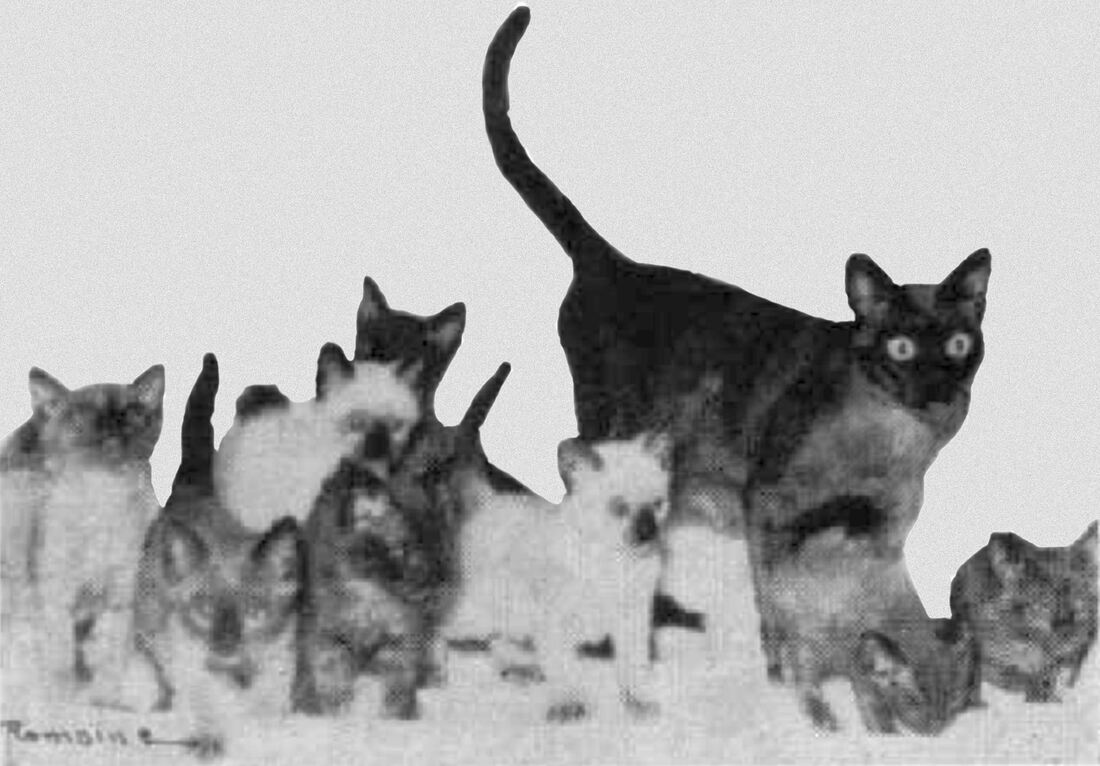
The Tonkinese, Wong Mau, with a litter of kittens (circa 1932). Note the three different coat-patterns in the kittens.
|
________________________________________________________________________________________________________________
|
2) WHAT MAKES A CAT A PEDIGREE?
If you are looking for a pedigree Tonkinese then take care not to be misled by false adverts on the various pets-for-sale web sites etc. These web sites do not check the adverts for accuracy.
|

GCCF Registration Certificate

Example pedigree - showing three generations' details
|
________________________________________________________________________________________________________________
3) WHAT DOES A TONKINESE LOOK LIKE?
There are a great many photos on the internet but for accuracy look at those on the web sites of a Tonkinese club as they will only post pictures of proper pedigree Tonkinese.
The Tonkinese is a strong healthy cat-shaped cat with a touch of the exotic. It has no extreme features and the well-balanced shape of the face, the medium-long body balanced by a not-too-slender tail, oval paws and rippling muscles ensure that this is a very handsome animal – and heavier than it looks. The females are generally a little more dainty and smaller than the males.
There are a great many photos on the internet but for accuracy look at those on the web sites of a Tonkinese club as they will only post pictures of proper pedigree Tonkinese.
The Tonkinese is a strong healthy cat-shaped cat with a touch of the exotic. It has no extreme features and the well-balanced shape of the face, the medium-long body balanced by a not-too-slender tail, oval paws and rippling muscles ensure that this is a very handsome animal – and heavier than it looks. The females are generally a little more dainty and smaller than the males.
The Tonkinese has many different colours (please note that the colours do not always reproduce well from photos here):
Top Row Left to Right : Brown, Blue, Chocolate, Cinnamon, Lilac and Fawn,
Bottom Row Left to Right: Blue-based Caramel, Lilac-based Caramel, Red, Cream and Apricot.
Top Row Left to Right : Brown, Blue, Chocolate, Cinnamon, Lilac and Fawn,
Bottom Row Left to Right: Blue-based Caramel, Lilac-based Caramel, Red, Cream and Apricot.

______________________________________________________________________________
The Tonkinese has four colour patterns (i.e. how the colour is arranged):
- Self (i.e. only one colour) – these come in all of the colours above.
- Tabby (i.e. stripes on the face legs and tail with stripes, spots or ticking in the body) – these come in all of the colours above.
- Tortoiseshell (i.e. mottled or mingled colours) – these come in all of the colours above except for Red, Cream and Apricot.
- Tortie-Tabby (i.e a combination of the tortoiseshell and tabby) – these come in all the colours of the Tortoiseshell.

Left to Right, the four colour-patterns: Self, Tabby, Tortoiseshell and Tortie-Tabby
______________________________________________________________________________
The Tonkinese has three Coat-Patterns (i.e. the intensity of colour over the coat).
This is what makes the Tonkinese unique among cat breeds. It is the degree of body colour in relation to the point’s colour (the points are the face, ears, tail, legs and feet). Whatever colour and colour-pattern the cat is, it will come in one of these three coat-patterns:
This is what makes the Tonkinese unique among cat breeds. It is the degree of body colour in relation to the point’s colour (the points are the face, ears, tail, legs and feet). Whatever colour and colour-pattern the cat is, it will come in one of these three coat-patterns:
- The Burmese Colour Restriction (BCR, aka solid) – a high level of colour over almost all of the body that matches the shade of the points. The eye colour of the BCR Tonkinese ranges from yellow to green and only occasionally a green-toned blue.
- The Tonkinese Colour Restriction (TCR, aka mink) – a medium level of colour over almost all of the body that is lighter than, and gently merges with, the colour on the points (except in tabbies because of the stripes). The eye colour of the TCR is the Tonkinese glory, a beautiful greenish-blue or bluish-green colour, often referred to as aquamarine.
- The Colourpointed Pattern (CPP, aka pointed) – a low level of colour over almost all of the body distinctly separate from the strong colour on the points. The eye colour of the CPP Tonkinese is blue, which ranges from a pale china blue to bright and deep blue.
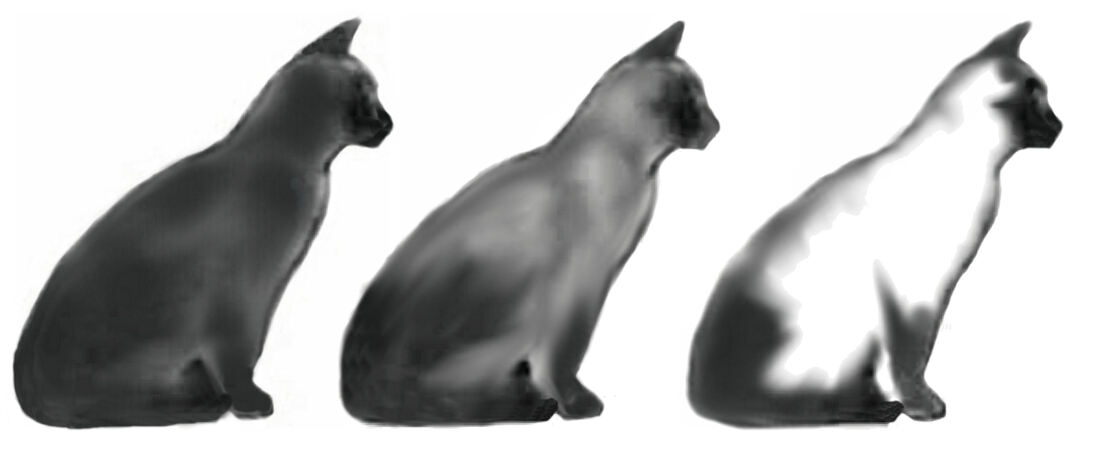
Left to Right: BCR (solid), TCR (Tonkinese, mink), CPP (pointed). Shown here in black and white to give a clearer understanding of the difference between coat-pattern and colour-pattern.
|
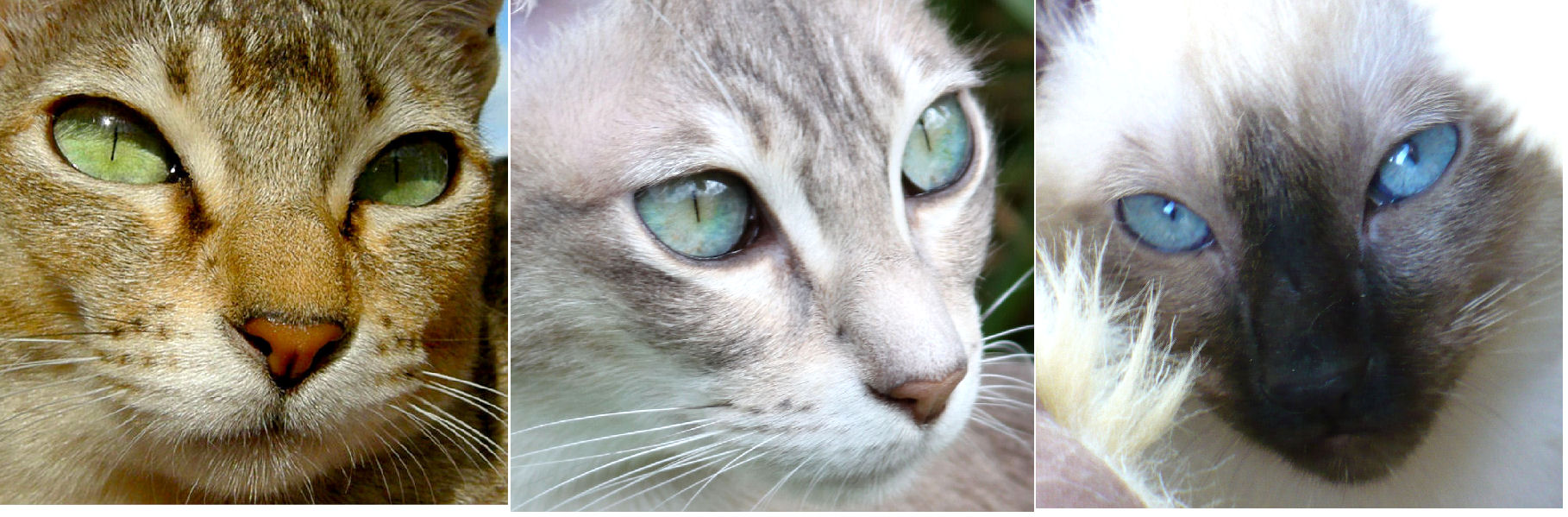
Associated eye colour - BCR, TCR and CPP
|
________________________________________________________________________________________________________________
|
4) WHAT IS THE TONKINESE CHARACTER?
“With your first Tonkinese kitten you are forever smitten!” These cats are highly intelligent, strong-willed, playful and very sociable. They need companionship – and feline companionship is essential. They can get on well with children and other animals as long as you introduce them with care. They are very active cats and if bored they can even be a little destructive (another good reason to make sure they have feline companionship). They like heights, they like to know what you are doing and how you are doing it and they like you to interact with them (otherwise what’s the point of having them?). They like to converse with you so be prepared to talk back. |
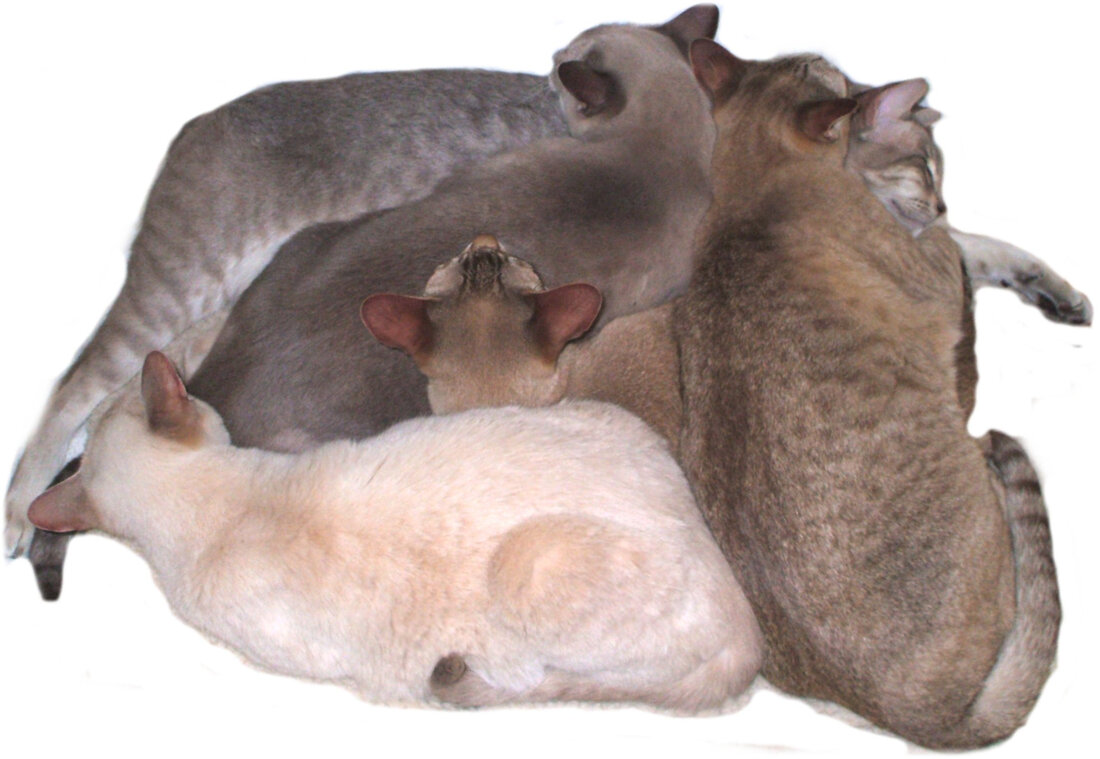
Tonks are very sociable and are happiest with feline companionship
|
________________________________________________________________________________________________________________
5) ARE TONKINESE EASY TO LOOK AFTER?
As long as you provide your Tonkinese with companionship, a clean warm bed, a clean litter tray, good quality food, a good cat vet and stimulation you’ll have few or no problems. Their lovely coats are short and lie close to the body so stroking is a pleasure and helps to remove those occasional loose hairs; a rubber brush or glove is also useful. There are many good books on general cat care.
If you choose your breeder carefully you will take home a Tonkinese that is well-socialised, confident, affectionate and healthy.
As long as you provide your Tonkinese with companionship, a clean warm bed, a clean litter tray, good quality food, a good cat vet and stimulation you’ll have few or no problems. Their lovely coats are short and lie close to the body so stroking is a pleasure and helps to remove those occasional loose hairs; a rubber brush or glove is also useful. There are many good books on general cat care.
If you choose your breeder carefully you will take home a Tonkinese that is well-socialised, confident, affectionate and healthy.
________________________________________________________________________________________________________________
|
6) BOOKS ON TONKINESE:
|
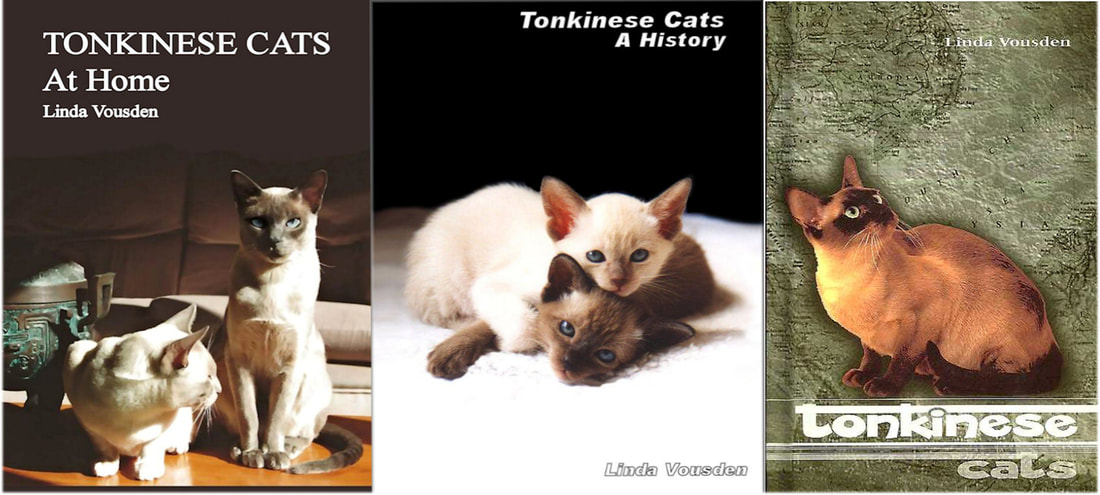
All three books are lavishly illustrated in full colour.
|
________________________________________________________________________________________________________________
7) MORE INFORMATION & MORE FAQS
More and more we find breeders using media such as Facebook rather than maintaining a website, which is a shame as it makes it more difficult for those looking to find a Tonkinese. However, the following web sites are recommended for their extra information on the Tonkinese:
Chorus Cats – L&M Smith
Mymystic Tonkinese – L Vousden
Rameses Tonkinese – J Craig-McFeely
The Tonkinese Breed Advisory
About Pedigree Tonkinese Cats
More and more we find breeders using media such as Facebook rather than maintaining a website, which is a shame as it makes it more difficult for those looking to find a Tonkinese. However, the following web sites are recommended for their extra information on the Tonkinese:
Chorus Cats – L&M Smith
Mymystic Tonkinese – L Vousden
Rameses Tonkinese – J Craig-McFeely
The Tonkinese Breed Advisory
About Pedigree Tonkinese Cats